February 27, 2026
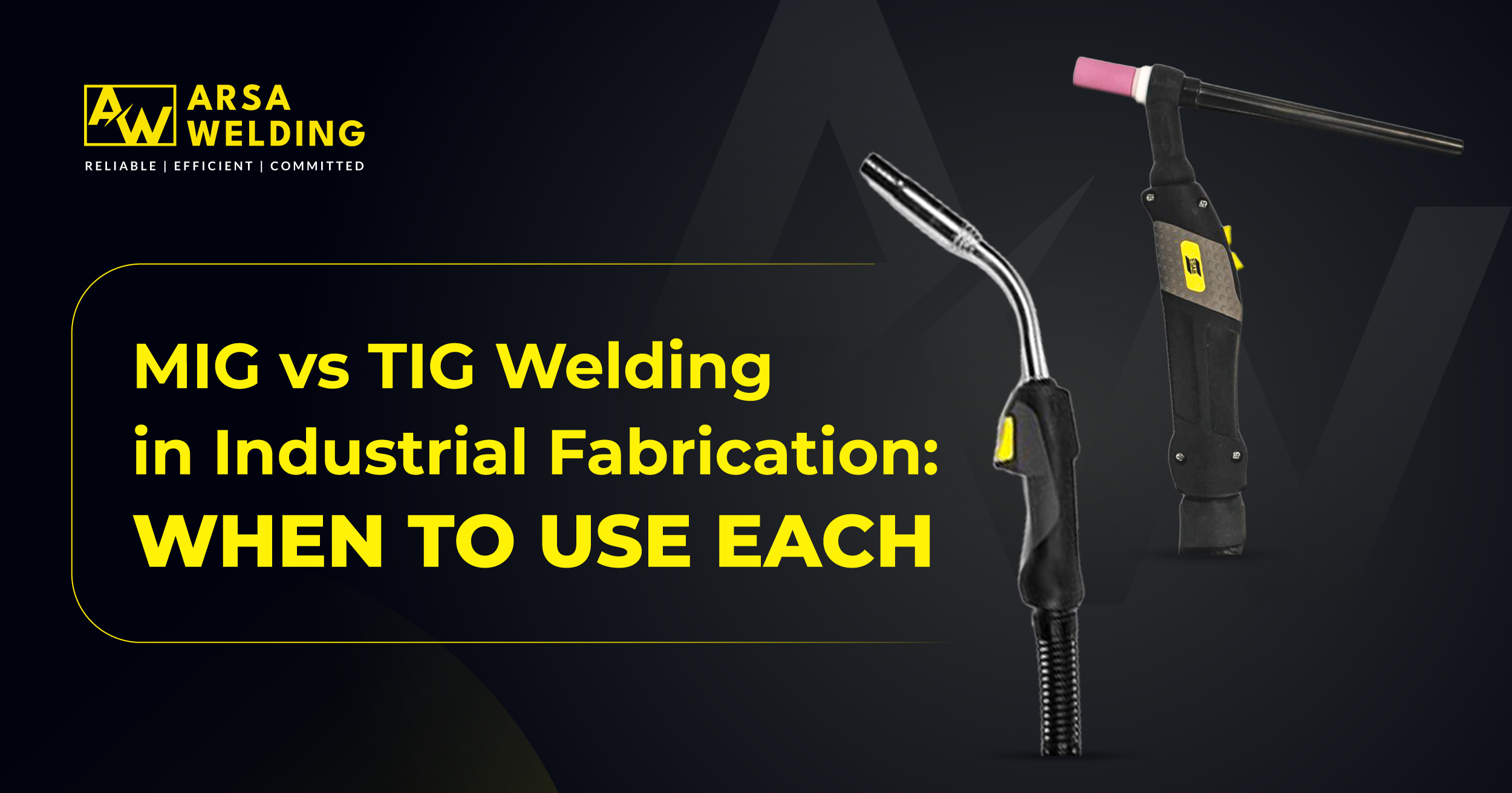
Industrial fabrication demands welding processes that balance speed, control, material compatibility, and cost efficiency. Two of the most widely used methods are MIG welding and TIG welding, each suited to different operational requirements.
For workshops, contractors, and engineering teams evaluating welding machines UAE, understanding the difference between a MIG welder and a TIG welder is essential for consistent performance and long-term productivity.
Understanding MIG Welding in Industrial Fabrication
MIG welding, also known as Gas Metal Arc Welding, operates through continuous wire feed and shielding gas. A modern GMAW welding machine is widely used in structural fabrication and production environments where output speed matters.
A MIG welder supports faster deposition rates and reduced stoppage time, making it ideal for:
- Structural steel fabrication
- Construction components
- General workshop production
Because of its efficiency, MIG welding equipment is often selected for projects where productivity directly impacts delivery timelines.
Understanding TIG Welding in Industrial Applications
TIG welding uses a non-consumable tungsten electrode and allows precise heat control. An industrial TIG welding machine is commonly selected when weld appearance, accuracy, and control are priorities.
A TIG welder performs particularly well in stainless steel and thin material applications, offering:
- Greater control over arc stability
- Cleaner weld finishes
- Reduced spatter
Although slower than MIG processes, TIG welding is preferred for pressure vessels, piping, and detailed fabrication where precision outweighs speed.
Speed vs Precision in Fabrication Work
In high-volume fabrication, a MIG welder typically provides greater efficiency and faster output. Continuous wire feeding allows operators to maintain workflow across repetitive tasks.
By contrast, a TIG welder supports refined control, especially in applications requiring accuracy and visual consistency. The trade-off is lower deposition speed but enhanced weld quality.
The decision ultimately depends on project scale, finish requirements, and delivery timelines.
Material Compatibility and Application Scope
Both MIG welding equipment and industrial TIG welding machines can be used on carbon steel, stainless steel, and alloyed materials.
However, TIG welding is often preferred for thinner materials and stainless assemblies requiring clean finishes. MIG welding is widely used for thicker structural components and general fabrication.
Industrial buyers evaluating welding machine manufacturers typically consider material type and operating conditions before selecting equipment.
Site Work vs Workshop Environments
In field-based operations such as construction sites, portability and durability are critical. A compact machinery welder or inverter-based MIG unit is often chosen for mobility and ease of use.
Workshop environments, especially those handling stainless fabrication or precision components, frequently integrate both MIG and TIG units to handle varied requirements efficiently.
Partnering with a reliable welding machine supplier ensures access to appropriate equipment, service support, and technical guidance.
Cost and Productivity Considerations
From a productivity perspective, MIG welding generally offers higher output per hour. TIG welding may require more time per weld but can reduce rework in precision-based applications.
Total cost considerations include:
- Equipment investment
- Consumable usage
- Operator skill level
- Service and maintenance availability
Working with authorised distributors of ESAB welding equipment ensures product authenticity, technical support, and access to an ESAB service centre or ESAB welding machine service center when required.
Conclusion
Both MIG welding and TIG welding play essential roles in industrial fabrication.
A MIG welder supports speed and production efficiency.
A TIG welder delivers precision and control for demanding applications.
For industrial operations across the UAE evaluating welding machines UAE, selecting the right process depends on material, project scope, and performance expectations.
ARSA Welding supports fabrication professionals with certified equipment, consumables, and service expertise as a trusted welding machine supplier in the region.
Explore More