

Find the Welding Consumables That Fit Your Work
Explore our range of welding consumables designed to support consistent weld quality across engineering and fabrication requirements. As an authorized distributor of ESAB, we provide access to trusted filler metals used by professionals around the world.
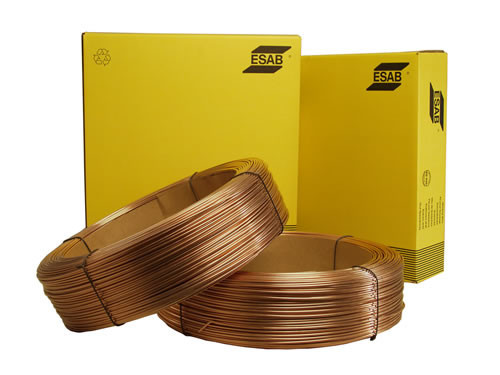
OK Autrod 13.27
Ni-alloyed, copper-coated wire for Submerged Arc Welding. With OK Flux 10.62 excellent toughness values; CTOD tested. For low temperature steels and fine grained steels in ship building, Off-Shore, pressure vessel industries, etc.
Low Alloy
Subarc (SAW)
.svg)
All
OK Autrod 13.43
Ni-, Cr-, Mo-alloyed, copper-coated wire for Submerged Arc Welding. Preferably in combination with OK Flux 10.62. For high strength steels with minimum yield strengths up to 690 MPa, low temperature steels, fine grained steels, etc.
Low Alloy
Subarc (SAW)
All
.jpg)
OK Pipeweld 7010 Plus
Cellulosic coated electrode for welding of low alloy steel pipes. Designed for vertical down welding, the deep penetrating arc provides good performance. Suitable for welding pipe steel types API 5L X52 to X60.
Classification
SFA/AWS A5.5: E7010-P1
Low Alloy
Stick Electrodes (SMAW)
All
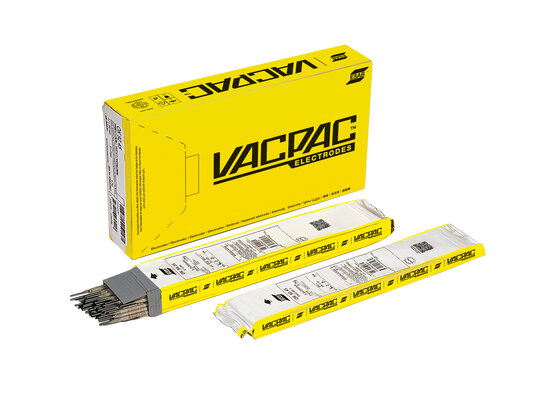
OK 73.15
OK 73.15 is a basic electrode with very good welding characteristics. Its exceptional weldability is ideal for multiple applications including Pipe. The electrode has a classification of AWS 8018-C3 H4R and gives a weld metal alloyed with about 0.9% Ni. It fulfils impact requirements down to - 50 °C. The low moisture absorption coating gives less than 4 ml diffusible hydrogen / 100 g welded metal. Weld metal recovery is above 120 % for the main diameters. OK 73.15 is HIC test compliant as per NACE TM0284 & SSC test compliant as per NACE TM0177.
Classification
SFA/AWS A5.5: E8018-C3 H4R
Low Alloy
Stick Electrodes (SMAW)
All
OK B3 SC
OK B3 SC is a basic AC/DC electrode designed for welding of creep resistant 2,25% Cr 1% Mo alloyed steels, SA-387 Grade 22, A335 Grade P22 or similar materials when highest toughness values are required also after step cooling treatment. Very low level of impurity elements providing a X-bar max. 10 for temper embrittlement resistant applications. Usually welding is followed by a PWHT. Suitable for refinery, petrochemical and chemical industries, power generation, pressure vessels, etc.
Classification
SFA/AWS A5.5: E9018-B3 H4 R
Low Alloy
Stick Electrodes (SMAW)
All
OK 73.68
Nickel alloyed basic AC/DC electrode for welding low alloyed steels with impact requirements down to -60 ᄚC, e.g. in offshore/onshore applications. The electrode is CTOD-tested.
Classification
SFA/AWS A5.5: E8018-C1
Low Alloy
Stick Electrodes (SMAW)
All
OK 76.28
Basic DC electrode for welding creep-resisting steels of the type 2.25 % Cr and 1 % Mo.
Classification
SFA/AWS A5.5: E9018-B3
Low Alloy
Stick Electrodes (SMAW)
All
PIPEWELD 8010 PLUS
Cellulosic coated electrode designed for low alloy steel. Deep penetration welding in all positions, especially designed for vertical down welding of high strength pipelines. Provides high economic benefits compared to welding vertical up. Recommended for welding pipe-lines of API 5LX: X60- X70.
Classification
SFA/AWS A5.5: E8010-P1
Low Alloy
Stick Electrodes (SMAW)
All
OK 76.18
Basic DC electrode for welding creep resisting steels of the type 1% Cr 0.5% Mo. Welds with a stable arc and minimum spatter. Deposits weld metal resistant to both cracking and porosity.
Classification
SFA/AWS A5.5: E8018-B2
Low Alloy
Stick Electrodes (SMAW)
All
OK 73.08
NiCu-alloyed electrode which deposits a weld metal with good corrosion resistance to sea water and flue gases, for the welding of weathering steels, e g Cor-Ten steel and ship's hull structural steel. The weld metal has excellent mechanical properties.
Classification
SFA/AWS A5.5: E8018-G
Low Alloy
Stick Electrodes (SMAW)
All
OK 74.46
OK 74.46 is an LMA electrode alloyed with 0.5% Mo for welding steels for pressure vessels. The running characteristics make it suitable for welding joints in the inclined positions. The composition of the coating is adapted for welding with low currents, making it very suitable for the welding of pipes.
Classification
SFA/AWS A5.5: E7018-A1
Low Alloy
Stick Electrodes (SMAW)
All
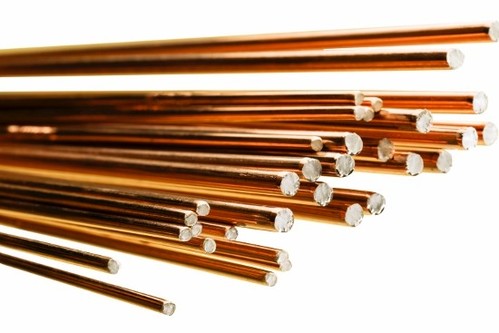
OK Tigrod 13.16
A copper coated, low-alloyed, chromium-molybdenum (1,3% Cr, 0,5% Mo), rod for GTAW of creep resistant steels like SA-387 Grade 11, A 335 Grade P11 or similar materials. OK Tigrod 13.16 is a high purity wire with a guaranteed Bruscato factor X<10.
Classification
EN ISO 21952-A: Z CrMo1Si
Low Alloy
MIG Wires / TIG Rods (GMAW/GTAW)
All
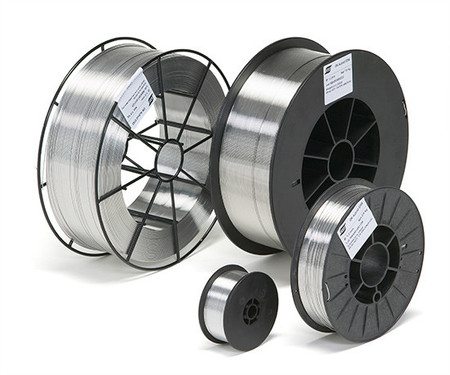
OK Autrod 13.25
A copper coated, low-alloyed, nickel-molybdenum-titanium (1,0 % Ni, 0,3% Mo, 0,1% Ti), solid wire for GMAW of low alloyed high tensile strength steels and fine grained steels for use in constructions such as bridges, off-shore and hoists with a minimum yield strength less than 610 Mpa. The alloy has good impact properties down to -60ᄚC. When used in mechanical pipe welding in narrow groove, yield strngths in excess of 700 MPa may be obtained, allowing overmatching of X80 pipeline steel.
Classification
EN ISO 16834-A: G 62 6 M21 Mn3Ni1Mo
Low Alloy
MIG Wires / TIG Rods (GMAW/GTAW)
All
OK Tigrod 55
A copper coated, low alloyed, chromium-nickel-molybdenum (0,5% Cr, 0,5% Ni, 0,2% Mo) rod for GTAW of high strength steels with a minimum tensile strength of 690 MPa. The rod is also suitable for welding of steels where a good impact strength at low temperatures is required.
Classification
EN ISO 16834-A: W 55 4 Mn3NiCrMo
Shielding Gas
I1 (EN ISO 14175)
Low Alloy
Gas-Shielded Flux-Cored Wires (FCAW/MCAW)
All
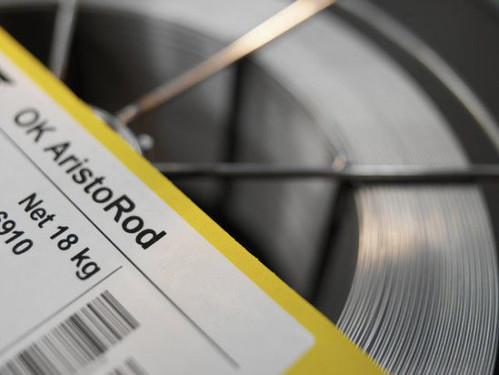
OK AristoRod 55
The non copper coated OK AristoRod 55 is a low-alloyed, chromium-nickel-molybdenum (0,5% Cr, 0,5% Ni, 0,2% Mo), solid wire for GMAW of high strength steels. But, also suitable when welding steels where good impact toughness is required at lower temperatures. The AristoRod wires are suitable for operating at high currents with maintained disturbance free wire feeding giving a stable arc with a low amount of spatter. OK AristoRod 55 delivered in the unique ESAB Octagonal Marathon Pac is excellent in mechanised welding applications.
Classification
EN ISO 16834-A: G 55 4 M20 Mn3NiCrMo
Shielding Gas
M21 (EN ISO 14175)
Low Alloy
MIG Wires / TIG Rods (GMAW/GTAW)
All
OK AristoRod 13.26
The non copper coated OK AristoRod 13.26 is a low-alloyed, nickel-copper (0,8% Ni, 0,45% Cu), solid wire for GMAW of weathering steels, such as COR-TEN, Patinax, Dillicor etc. According to NACE it would be acceptable to use these welding consumables, since the nickel content is below the maximum acceptable level, 1 % for sour gas applications. One other requirement from NACE is the maximum hardness of the deposited weld metal, which must not exceed 22 HRC. The weld metal composition and mechanical properties also make this product suitable for welding high strength steels with a minimum yield strength less than 470 MPa. The AristoRod wires are suitable for operating at high currents with maintained disturbance free wire feeding giving a stable arc with a low amount of spatter. OK AristoRod 13.26 delivered in the unique Esab Octagonal Marathon Pac is excellent in mechanised welding applications.
Classification
EN ISO 14341-A: G 42 0 C1 Z 3Ni1Cu
Shielding Gas
M21, C1 (EN ISO 14175)
Low Alloy
MIG Wires / TIG Rods (GMAW/GTAW)
All
OK Tigrod 13.08
A copper coated, low alloyed, manganese-molybdenum (1,5% Mn, 0,4% Mo) rod for GTAW of creep resistant steels of the same type, such as pipes in pressure vessels and boilers with a working temperature of up to about 500°C. The rod can also be used for welding low-alloyed high tensile strength steels.
Classification
EN ISO 636-A: W 50 3 Z 2Mo
Shielding Gas
I1 (EN ISO 14175)
Low Alloy
MIG Wires / TIG Rods (GMAW/GTAW)
All
OK AristoRod 13.09
The non copper coated OK AristoRod 13.09 is a low-alloyed, molybdenum (0,5% Mo), solid wire for GMAW of creep resistant steels of the same type, such as pipes in pressure vessels and boilers with a working temperature of up to 500 °C. The AristoRod wires are suitable for operating at high currents with maintained disturbance free wire feeding giving a stable arc with a low amount of spatter. OK AristoRod 13.09 delivered in the unique Esab Octagonal Marathon Pac is excellent in mechanised welding applications.
Classification
EN ISO 14341-A: G 38 0 C1 2Mo
Shielding Gas
M21, C1 (EN ISO 14175)
Low Alloy
MIG Wires / TIG Rods (GMAW/GTAW)
All
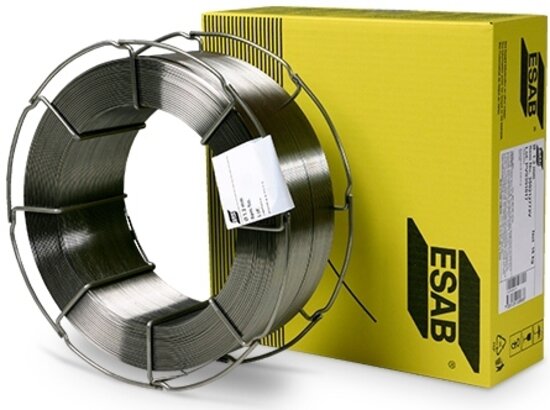
OK Tubrod 15.11
An all-positional rutile cored wire with good toughness down to -60 °C for the use with M21 shielding gas. Diameters less than 1.4mm are all-positional except vertical down.
Classification
SFA/AWS A5.29: E81T1-Ni2M
Shielding Gas
M21 (EN ISO 14175)
Low Alloy
Gas-Shielded Flux-Cored Wires (FCAW/MCAW)
All
Pipeweld 111T-1
An all positionable rutile flux cored wire that is used with Ar-CO2 shielding gas.This wire offers excellent weldability. Suitable for up to X100 strength pipe.
Classification
SFA/AWS A5.29: E111T1-K3MJ-H4
Shielding Gas
M21 (EN ISO 14175)
Low Alloy
Gas-Shielded Flux-Cored Wires (FCAW/MCAW)
All
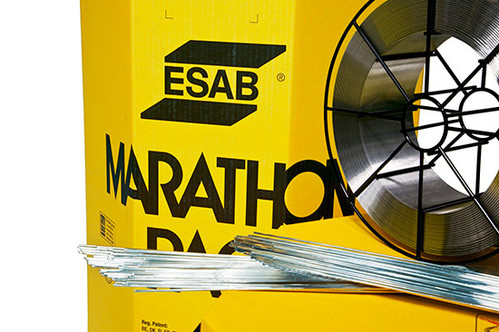
OK Tubrod 14.05
A 1% Ni metal cored wire which gives good toughness down to -40 degrees C using M21 shielding gas.
Classification
SFA/AWS A5.28: E70C-GM
Shielding Gas
M21 (EN ISO 14175)
Low Alloy
Gas-Shielded Flux-Cored Wires (FCAW/MCAW)
All
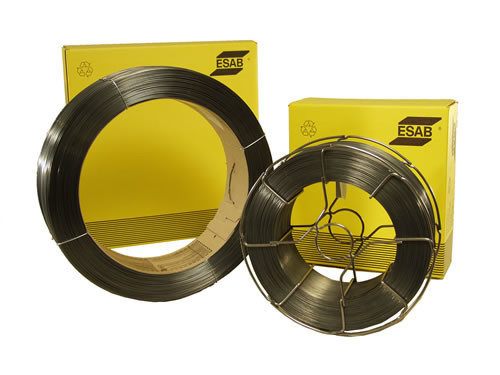
Coreweld 69 LT H4
A metal cored wire for the welding of high strength steels (>690 MPa) with excellent sub-zero toughness down to -60 degrees C and low diffusible hydrogen levels. Suitable for welding with Ar/CO2 gas mixtures.
Classification
SFA/AWS A5.28: E110C-G-H4
Shielding Gas
M21 (EN ISO 14175)
Low Alloy
Gas-Shielded Flux-Cored Wires (FCAW/MCAW)
All
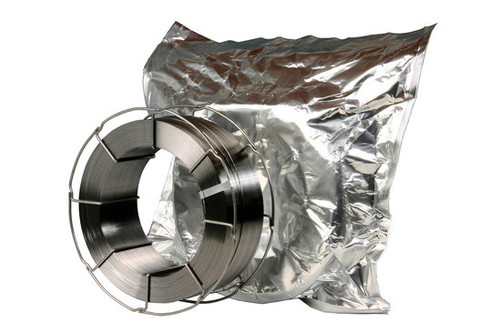
Dual Shield CrMo2
Dual Shield CrMo2 is an all position rutile, low-hydrogen flux-cored wires for welding 2.25%Cr/1%Mo creep resisting steels. Designed for use in Ar/CO2 shielding gas, it has excellent weldability and produce flat beads with good wetting and appearance with good impact toughness down to -20°C after stress relieving.
Classification
SFA/AWS A5.29: E91T1-B3M
Shielding Gas
M21 (EN ISO 14175)
Low Alloy
Gas-Shielded Flux-Cored Wires (FCAW/MCAW)
All
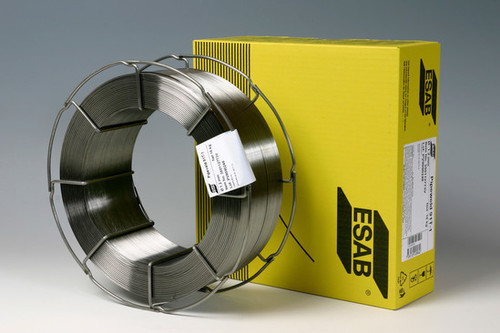
Pipeweld 101T-1
An all-positional rutile cored wire for pipe welding of steels with a minimum strength of 610 MPa, for use with M21 shielding gas.
Classification
SFA/AWS A5.29: E101T1-G
Low Alloy
Gas-Shielded Flux-Cored Wires (FCAW/MCAW)
All
OK Tubrod 14.03
A metal cored wire for high strength applications (>690 Mpa) for use with M21 shielding gas. Diameters less than 1.4mm are all-positional except vertical down.
Classification
SFA/AWS A5.28: E110C-G
Shielding Gas
M21 (EN ISO 14175)
Low Alloy
Gas-Shielded Flux-Cored Wires (FCAW/MCAW)
All
OK Tigrod 13.12
A copper coated, low alloyed, chromium-molybdenum (1% Cr, 0,5% Mo) rod for GTAW of creep resistant steels of the same type, such as pipes in pressure vessels and boilers. The rod can also be used for welding low-alloyed high strength steels with a minimum tensile strength of 550 Mpa.
Classification
EN ISO 21952-A: W CrMo1Si
Shielding Gas
I1 (EN ISO 14175)
Low Alloy
MIG Wires / TIG Rods (GMAW/GTAW)
All
OK AristoRod 89
The non copper coated OK AristoRod 89 is a low-alloyed, chromium-nickel-molybdenum (0,4% Cr, 2,2% Ni, 0,55% Mo), solid wire for GMAW of ultra high tensile strength steels requiring tough weld metal for critical applications. Also suitable when high impact strength at lower temperatures is required. The AristoRod wires are suitable for operating at high currents with maintained disturbance free wire feeding giving a stable arc with a low amount of spatter, due to its unique Advanced Surface Characteristics ASC) technology. OK AristoRod 89 is delivered on spools or in the unique ESAB Octagonal Marathon Pac, which is excellent in mechanised weldingapplications. Typical materials is according to ISO 15608:2000 and some brand names from steel suppliers are S890QL, Weldox 900,1100,1300,Domex 960,XABO 890,960,1100, NAXTRA 70, OX-700,800,1002, Optim 900QC, 960QC, 1100QC,T1 - HY80.
Classification
EN ISO 16834-A: G Mn4Ni2CrMo
Shielding Gas
M21 (EN ISO 14175)
Low Alloy
MIG Wires / TIG Rods (GMAW/GTAW)
All
OK Tigrod 13.09
A copper coated, low alloyed, molybdenum (0,5% Mo) rod for GTAW of creep resistant steels of the same type, such as pipes in pressure vessels and boilers with a working temperature of up to about 500 ᄚC.
Classification
EN ISO 636-A: W 46 2 2Mo
Shielding Gas
I1 (EN ISO 14175)
Low Alloy
MIG Wires / TIG Rods (GMAW/GTAW)
All
OK Autrod 13.24
Ni-, Mo-alloyed, copper-coated wire for Submerged Arc Welding. With OK Flux 10.62 excellent toughness values; CTOD tested. For low temperature steels and fine grained steels in ship building and Off-Shore industries, etc.
Low Alloy
Subarc (SAW)
All
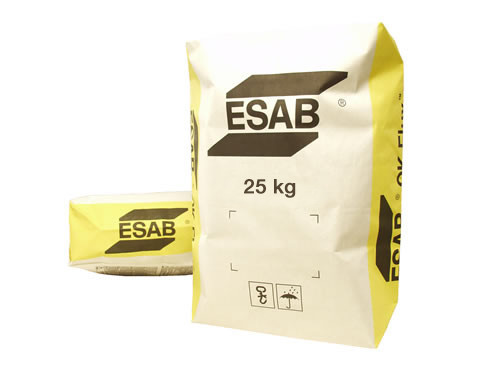
OK Flux 10.65
Agglomerated fluoride-basic flux for Submerged Arc Welding. Especially for combination with OK Autrod B3 SC. Designed for multi-run welding of creep resistant Cr-, Mo-alloyed steels when highest toughness values are required also after step cooling treatment. Very low level of impurities and thus exceptionally clean weld metal. X-bar max. 10 with the wire as above. Mainly for petrochemical and chemical industries, power generation, pressure vessels, etc. Suitable for narrow gap welding. Low-oxygen weld metal (approx. 300 ppm) and hydrogen contents lower than 5 ml/100 g, in BlockPac (moisture protection) maximum 4 ml/100g. Designed for single and multi wire procedures, welds equally well on DC and AC current. Mainly for multi layer welding of unlimited plate thickness.
Low Alloy
Subarc (SAW)
All
OK Autrod 12.24
Mo-alloyed, copper-coated wire for Submerged Arc Welding. For creep resistant steels (0,5% Mo), structural steels, ship building steels, pressure vessel steels, pipeline steels up to X70, etc.
Low Alloy
Subarc (SAW)
All
OK Autrod 13.40
Ni-, Mo-alloyed, copper-coated wire for Submerged Arc Welding. Preferably in combination with OK Flux 10.62. For high strength steels with minimum yield strengths up to 550 MPa (in AC current up to 620 MPa), low temperature steels, fine grained steels, etc.
Low Alloy
Subarc (SAW)
All
OK Tubrod 14.02S
A metal cored wire containing 0.5% Mo for submerged arc welding.
Low Alloy
Subarc (SAW)
All
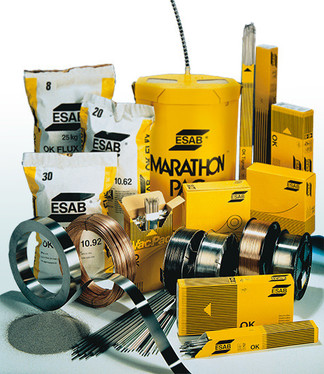
OK Tubrodur 15CrMn O/G
A cored wire which produces a work-hardening austenitic weld metal with high wear and impact resistance. Used with C1 shielding gas or self-shielded.
Hard Facing
Self-Shielded Flux-Cored Wires (FCAW)
All
OK Weartrode 55 HD
A general purpose hardfacing electrode depositing a semi corrosion resistant martensitic steel with a hardness of about 57 HRC. The electrode is specially suitable for hardfacing parts exposed to different forms of abrasive and impact wear, e.g. farming equipment, forestry tools, loading machines and mixers.
Hard Facing
Stick Electrodes (SMAW)
All
OK 13Mn
OK 13Mn is an austenitic manganese steel electrode which work hardens under impact and compressive stresses. It is primarily used for surfacing and building up manganese steel components exposed to severe impact and moderate abrasion. Typical applications include crusher plates and rolls, cones and mantles of rotary crushers etc. The interpass temperature should be kept as low as possible.
Hard Facing
Stick Electrodes (SMAW)
All
OK Tubrodur 58 O/G M
A hardfacing cored wire which gives Hv 550 - 650. Can be used with C1 shielding gas or self-shielded.
Classification
EN 14700: T Fe6
Shielding Gas
None, C1 (EN ISO 14175)
Hard Facing
Self-Shielded Flux-Cored Wires (FCAW)
All
OK Tubrodur 30 O M
A self-shielded cored wire which gives a Cr Mn alloyed weld metal for semi-automatic hardfacing.
Classification
EN 14700: T Z Fe1
Shielding Gas
None
Hard Facing
Self-Shielded Flux-Cored Wires (FCAW)
All
OK Tubrodur 35 O M
A self-shielded cored wire which gives a Cr-Ni-Mo alloyed weld metal for rail surface repair.
Classification
EN 14700: T Z Fe3
Shielding Gas
None
Hard Facing
Self-Shielded Flux-Cored Wires (FCAW)
All
OK Tubrodur 40 O M
A self-shielded cored wire depositing a Cr-Ni-Mo alloyed weld metal.
Classification
EN 14700: T Z Fe2
Shielding Gas
None
Hard Facing
Self-Shielded Flux-Cored Wires (FCAW)
All
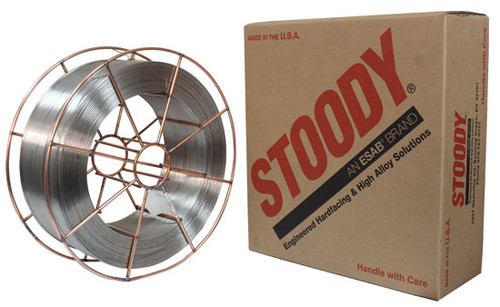
Stoody 102-O
Stoody 102 deposit has a composition and physical properties that are similar to those of H-12 tool steel. Weldability is very good and the wire can be applied out-of-position. Stoody 102 requires carbide tools for machining. It is good for hot wear applications up to 1100F.
Hard Facing
Gas-Shielded Flux-Cored Wires (FCAW/MCAW)
All
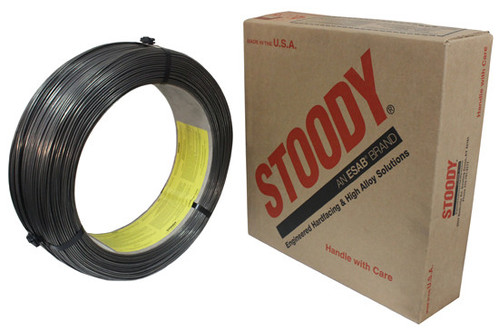
STOODY 110, 110-G, 110-O, 110-MC
Stoody 110 deposit is a modified chromium, high manganese steel used in the rebuilding of manganese steel parts subject to severe impact loading. This material offers good toughness and wear resistance, and is sometimes used as the final hardfacing layer in extreme impact situations.
Hard Facing
Self-Shielded Flux-Cored Wires (FCAW)
All
Stoody 134-O
Stoody 134 deposit is a high chromium-iron alloy recommended for applications subject to severe abrasion, moderate impact, and high compressive loads. It can be deposited on carbon, low alloy, and manganese steel.
Hard Facing
Self-Shielded Flux-Cored Wires (FCAW)
All
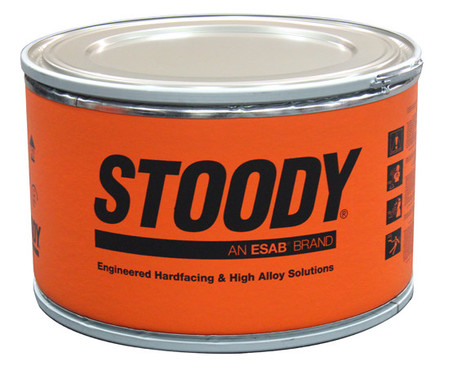
Stoody 117-O
Stoody 117 deposit consists of uniformly dispersed chromium carbides in a semi-austenitic matrix that provides a deposit with good impact, abrasion, and anti-galling properties. It develops a light crosschecking patter which allows this material to be applied in multiple layers without difficulty.
Hard Facing
Self-Shielded Flux-Cored Wires (FCAW)
All
Stoody SOS 430
The SOS® 430 deposit is ferritic stainless steel. This open arc wire can be used as a single layer underlay for the SOS 423 wire. The wire is specifically designed for one layer underlay on continuous caster rolls, prior to the applications of the SOS 423 overlay. The wire must not be used to deposit a final overlay on continuous caster rolls. The alloy does not require a post-weld heat treatment or temper.
Hard Facing
Self-Shielded Flux-Cored Wires (FCAW)
All
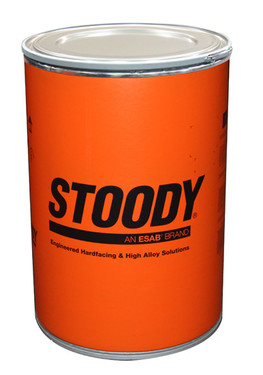
Stoody 101HWP
Stoody 101HWP is a chromium carbide alloy designed to generate primary carbides in the first layer. 101HWP exhibits superior wear in both single and double layer overlays in one or two layer wear plates. The alloy is optimized for superior weldability for weave and stringer bead deposits on plate.
Hard Facing
Self-Shielded Flux-Cored Wires (FCAW)
All
Stoody 111-G, 111-O
Stoody 111-O is an open arc wire that produces a austenitic chromium manganese steel deposit containing alloy carbides. Stoody 111-O deposit is used in the rebuilding of manganese steel parts subject to severe impact loading combined with abrasion. The abrasion resistance of Stoody 111-O deposit is 5-6 times superior to that of an austenitic manganese deposit as measured in the G65 test. This material offers good toughness and wear resistance, and is sometimes used as the final hardfacing layer in extreme impact situations. It can be used on carbon and manganese steels.
Hard Facing
Self-Shielded Flux-Cored Wires (FCAW)
All
Stoody PR2009-O
Stoody PR2009 is a chromium carbide wire designed specifically for the repair of worn ID claddings in pipe elbows. PR2009 is optimized to result in superior weldability for overlaying pipe ID in the horizontal position. Special deoxidizers within PR2009 make it possible to achieve sound ID claddings when repairing worn chromium carbide overlays with hydrocarbon contamination embedded in existing relief cracks.
Hard Facing
Self-Shielded Flux-Cored Wires (FCAW)
All
Stoody 100HC-O
Stoody 100HC deposit is a high chromium-iron alloy recommended for application subject to severe abrasion and moderate impact and heat. It develops a very tight (3/8 - 1/2 inch) cross checking pattern and is frequently used in crushing applications. It is generally limited to two layers. In the rebuilding of coal pulverizer rolls, however, multiple layers can be applied using specific welding procedures. It can be applied using specific welding procedures. It can be applied to carbon, low alloy, and manganese steels.
Hard Facing
Self-Shielded Flux-Cored Wires (FCAW)
All
Stoody SA Nicromang-O
Nicromang deposit is a typical 13 - 16% manganese steel alloy with additions of chromium and nickel to improve its weldability and physical properties. It is primarily used for build up, repair, and joining of manganese steels.
Hard Facing
Self-Shielded Flux-Cored Wires (FCAW)
All
Stoody CP-2001-O
A specially formulated chromium carbide alloy designed to produce a high concentration of uniformly distributed small primary carbides and secondary Niobium and Vanadium carbides in an austenitic matrix. CP-2001 has been optimized for superior single and multiple layer applications and can be applied to carbon, low alloy, and manganese steels - and even cast irons in coal pulverizer rebuilds.
Hard Facing
Self-Shielded Flux-Cored Wires (FCAW)
All
Stoody StoodCor 136-O
STOODCOR 136 is an erosion and corrosion resistant alloy with complex carbide design well suited for hardfacing and cladding applications where erosion and corrosion are of equal concern. The ability of STOODCOR 136 to resist high abrasion in a corrosive environment makes the alloy optimal for hardfacing and cladding pipe, plate and vessels.
Nickel
Self-Shielded Flux-Cored Wires (FCAW)
All

Stoody Dynamang-O
Dynamang deposit is an austenitic manganese steel containing chromium and some nickel. It produces a tough, high-strength deposit that work hardens under impact. It is primarily used for the build up, repair, and joining of manganese steel components in the cement, rock-crushing and mining industries.
Hard Facing
Self-Shielded Flux-Cored Wires (FCAW)
All
Stoody PC2009
Stoody PC2009 is a chromium carbide wire designed specifically for the application of abrasion resistant deposits inside pipe. The alloy is optimized to result in superior weldability for overlaying pipe ID in the flat position and elbows in the horizontal position. Stoody PC2009 can be used in hot wear applications up to 900°F (482°C).
Hard Facing
MIG Wires / TIG Rods (GMAW/GTAW)
All
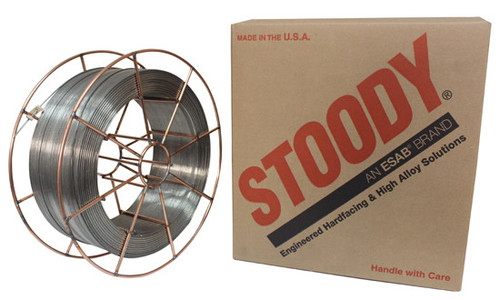
Stoody 160
Stoody 160 wire consists of tungsten carbide particles in a nickel silicon boron matrix. This microstructure gives Stoody 160 superior toughness, corrosion and excellent fine particle erosion resistance in slurry type applications.
Hard Facing
MIG Wires / TIG Rods (GMAW/GTAW)
All
OK Autrodur 56 G M
A copper coated, low-alloyed solid GMAW wire used for hard facing and building up highly wear resistant layers on tools and machinery parts, driving rollers, digging tools etc. The hardness of the weld metal becomes 50-60 HRC.
Classification
EN 14700: Fe8
Shielding Gas
M21, C1 (EN ISO 14175)
Hard Facing
MIG Wires / TIG Rods (GMAW/GTAW)
All
Stoody 160
Stoody 160 wire consists of tungsten carbide particles in a nickel silicon boron matrix. This microstructure gives Stoody 160 superior toughness, corrosion and excellent fine particle erosion resistance in slurry type applications.
Hard Facing
MIG Wires / TIG Rods (GMAW/GTAW)
All
Stoody CP2000
Stoody CP-2000 is designed to produce a high concentration of uniformly distributed small primary chromium carbides in an austenitic matrix. The formulation is optimized for superior weldability in single and multiple layer applications. CP-2000 exhibits improved wear resistance and toughness over conventional chromium carbide alloys.
Hard Facing
MIG Wires / TIG Rods (GMAW/GTAW)
All
Stoody 966-G
Stoody 966-G is a molybdenum-tungsten high speed tool steel with a high concentration of uniformly distributed small primary carbides. The presence of the small carbides greatly improve the wear resistance when compared to M-7 tool steel. Stoody 966-G provides wear resistance greater than or equal to that of conventional chromium carbides but does not cross check when proper preheat and welding procedures are used. It is recommended for parts where cross checking is undesirable. It can be applied crack free without preheat on carbon, 300 series stainless and manganese steels. Preheat and interpass temperatures shall be determined by base metal requirements. Post weld heat treatment may be required for other base metals. The deposit will crack on cast irons.
Hard Facing
MIG Wires / TIG Rods (GMAW/GTAW)
All
Stoody VANCAR-O
VANCAR weld deposits contain vanadium carbides, with a wear resistance similar to that of tungsten carbide but with superior impact resistance. A unique feature of this alloy is that the vanadium carbides dissolve and reform in the weld deposit creating an even distribution.
Hard Facing
MIG Wires / TIG Rods (GMAW/GTAW)
All
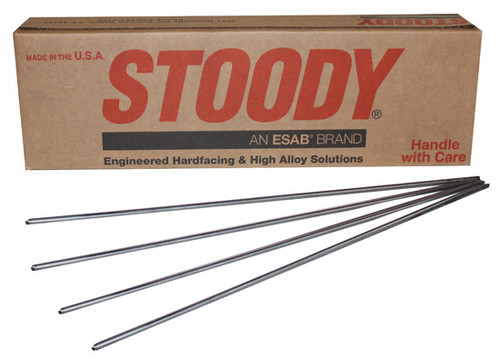
Stoody Horseshow Borium
Stoody Horseshoe Borium was developed to provide a maximum non-slipping surface when applied to horseshoes. It is manufactured by metering relatively large tungsten carbide particles into steel.
Hard Facing
MIG Wires / TIG Rods (GMAW/GTAW)
All
Stoodite 12-M
Stoodite 12-M is a more wear resistant cobalt alloy than 6-M thanks to a higher volume of carbides but with lower impact strength. Produces a high hardness cobalt-chromium deposit for high temperature applications with abrasive wear associated with corrosion. Provides excellent resistance to many forms of chemical and mechanical degradation, including galling. Stoodite 12-M bonds well with all weldable steels, including stainless. Certification to AWS specification - A5.21 ERCCoCr-B
Classification
AWS A5.21: ERCCoCr-B
Hard Facing
MIG Wires / TIG Rods (GMAW/GTAW)
All
Stoody M7-G
Stoody M7-G deposit is a molybdenum high speed tool steel similar to AISI M7 grade.
Hard Facing
MIG Wires / TIG Rods (GMAW/GTAW)
All
Stoodite 6-M
Stoodite 6-M is the most widely used cobalt alloy with excellent resistance to many forms of mechanical and chemical degradation over a wide temperature range. Stoodite 6-M attributes include its outstanding self mated anti-galling properties, high temperature hardness, and high resistance to cavitation erosion. Certification to AWS specification - A5.21 ERCCoCr-A
Classification
AWS A5.21: ERCCoCr-A
Hard Facing
MIG Wires / TIG Rods (GMAW/GTAW)
All
Stoody Build-Up-G
Stoody Build-Up is a low alloy wire with deposits exhibiting excellent compressive strength and resistance to plastic deformation. Build-up is a perfect choice for use as a buffer or build up layer to be covered by subsequent overlay hardfacing. Work hardens under impact.
Hard Facing
MIG Wires / TIG Rods (GMAW/GTAW)
All
Stoody 964-G
Stoody 964-G deposit is a specially formulated wear resistant alloy which produces a uniform distribution of small primary carbides in a martensitic matrix. The small carbides provide greatly improved wear resistance over martensitic steel, many tool steels, and some conventional chromium carbide alloys. Stoody 964-G possesses excellent resistance to impact and plastic deformation. Deposits are crack free on carbon 300 stainless and manganese steels. Other base metals should be preheated and post heated appropriately. The material is characterized by a high hardness and excellent wear resistance and is recommended for parts where cross checking is undesirable. Stoody 964-G offers improved weldability over chromium carbide and many other tool steel welding wires.
Hard Facing
MIG Wires / TIG Rods (GMAW/GTAW)
All
Stoody Bare BOROD
Stoody Bare Borod hardfacing rod is used for metalto-earth applications requiring extreme abrasion resistance and low impact resistance. It is similar to Stoody Bare Acetylene Tube Borium in all respects except that the mesh size is finer (40-down) to provide deposits resembling fine grit sandpaper. The finer mesh size generally provides slightly increased wear protection.
Hard Facing
MIG Wires / TIG Rods (GMAW/GTAW)
All
Stoody Super Build-Up-G
Stoody Super Build Up deposit is a low alloy steel that can be used both as a build-up and hardfacing material because it has good compressive strength and hardness.
Hard Facing
MIG Wires / TIG Rods (GMAW/GTAW)
All
Stoody Tube Borium H
Stoody Tube Borium H Rod is a bare rod manufactured by metering special mesh sizes of tungsten carbide particles into thin tubes.
Hard Facing
MIG Wires / TIG Rods (GMAW/GTAW)
All
Stoody HB-56
Stoody HB-56 is a general purpose non-cracking hardbanding alloy that offer high hardness in a casing friendly deposit. HB-56 offers a balance of impact and abrasion resistance and can be applied to carbon and low alloy steels with or without tungsten carbide addition. Deposits are crack free when applied over new or properly rebuilt tool joints using appropriate preheats.
Hard Facing
MIG Wires / TIG Rods (GMAW/GTAW)
All
Stoody 965-O
Stoody 965-O is a general purpose hardfacing alloy offering a good balance of impact and abrasion resistance. Can be applied to carbon, low alloy and manganese steel. Applications would include both metal-to-metal and metal-to-earth.
Hard Facing
MIG Wires / TIG Rods (GMAW/GTAW)
All
Stoody 160FC/160FC-O
Stoody 160FC wire deposit consists of tungsten carbide particles in a nickel silicon boron matrix. Due to higher tungsten carbide content, Stoody 160FC is an ideal hardfacing overlay with a microstructure that delivers superior toughness and resistance to corrosion and fine particle erosion in slurry type applications. Stoody 160FC also provides improved weldability through enhanced wetting, tie-in, and arc stability.
Hard Facing
MIG Wires / TIG Rods (GMAW/GTAW)
All
Stoody 965-G
Stoody 965-G is a general purpose hardfacing alloy offering a good balance of impact and abrasion resistance. Can be applied to carbon, low alloy and manganese steel. Applications would include both metal-to-metal and metal-to-earth.
Hard Facing
MIG Wires / TIG Rods (GMAW/GTAW)
All
OK Tubrodur 53 G M
A cored wire which produces a Cr-Mo-V-Co-W alloyed weld metal for hardfacing used with C1 shielding gas.
Classification
EN 14700: T Fe3
Shielding Gas
C1 (EN ISO 14175)
Hard Facing
Gas-Shielded Flux-Cored Wires (FCAW/MCAW)
All
OK Tubrodur 35 G M
A hardfacing cored wire for rebuilding and surfacing with C1 shielding gas.
Classification
EN 14700: T Fe1
Shielding Gas
C1 (EN ISO 14175)
Hard Facing
Gas-Shielded Flux-Cored Wires (FCAW/MCAW)
All
OK Tubrodur 60 G M
A 5%Cr - 1%Mo alloyed metal cored wire for use with carbon dioxide shielding gas.
Classification
EN 14700: T Z Fe2
Shielding Gas
C1 (EN ISO 14175)
Hard Facing
Gas-Shielded Flux-Cored Wires (FCAW/MCAW)
All
Stoody 155FC
Stoody 155FC wire consists of tungsten carbide particles in a nickel silicon boron matrix. Designed for multiple pass operations where cross checking is undesirable. Stoody 155FC deposits are ideal when thicker nickel, silicon, boron tungsten carbide weld deposits are desired. Slightly reduced tungsten carbide produces greater ductility making Stoody 155FC a superior buffer layer for more wear resistant overlay alloys like Stoody 160FC.
Hard Facing
Gas-Shielded Flux-Cored Wires (FCAW/MCAW)
All
Stoody 964 AP-G
Stoody 964 AP-G is a gas shielded flux cored general purpose hardfacing wire. Deposits from this all-position wire provide exceptional wear resisteance and high hardness. On Series 300 stainless and manganese steels, deposits are crack free. Other base metals should be preheated and post-heated appropriately. Stoody 964AP-G provides improved weldability over chromium carbide and many other tool steel welding wires. Use 964 AP-G where cross checking is undesirable.
Hard Facing
Gas-Shielded Flux-Cored Wires (FCAW/MCAW)
All
Stoody ATB
Bare Acetylene Tube Borium is an oxy-fuel rod intended for metal-to-earth applications involving extreme abrasion and low impact. It is manufactured by metering crushed tungsten carbide particles of controlled mesh size into steel tubes.
Hard Facing
Oxy-Fuel Rod
All
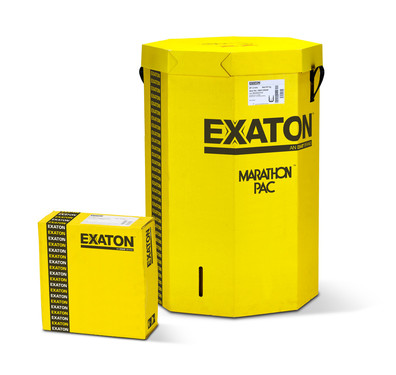
Exaton Ni56 (GMAW)
Exaton Ni56 is a low carbon nickel-chrome-molybdenum alloy of type alloy C-276. It is a versatile alloy with excellent wet corrosion resistance in oxidizing and especially in reducing media. However, in oxidizing chloride containing environments alloy UNS N06022 (2.4602) is preferred where Exaton Ni56 is a better matching welding consumable. Applications for Exaton Ni56 are found in aggressively corrosive media such as chemical processing plants, pollution control, pulp and paper production, waste treatment and for the recovery of sour natural gas. Exaton Ni56 is used for joining and overlay welding with MIG/MAG, plasma and hot wire TIG and mechanized TIG. Typical alloys are UNS N10276 (2.4819) and other nickel-chrome-molybdenum alloys. It can also be used for dissimilar metal joining of nickel alloys, stainless steels and low-alloy steels. Applications for Exaton Ni56 are found in cryogenics, components in pulp and paper plants such as bleaching vessels, flue gas scrubber systems, components in sour-gas service, sulphuric acid coolers, chlorine gas, hypochlorite and chlorine dioxide atmosphere. Exaton Ni56 is also used in combustion-resistant components for high pressure oxygen service.
Classification
SFA/AWS A5.14: ERNiCrMo-4
Shielding Gas
M12 (EN ISO 14175)
Nickel
MIG Wires / TIG Rods (GMAW/GTAW)
All
Exaton Ni41Cu (GMAW)
Exaton Ni41Cu welding wire is suitable for overlay welding when a deposit with chemistry corresponding to UNS N08825 is required. The weld deposit is a nickel-iron-chromium-molybdenum-copper alloy suitable for use in corrosive environments. Exaton Ni41Cu can also be used for dissimilar joining of stainless steels to nickel alloys and plasma welding and overlay welding using hot wire TIG and mechanized TIG. Exaton Ni41Cu has very good resistance to stress corrosion cracking (SCC) in chloride containing environments and is particularly suited for use in reducing environments such as those containing sulphuric and phosphoric acids. Exaton Ni41Cu is used for corrosion resistant alloy surfacing of components in the chemical, pollution control, oil and gas and petrochemical industries and often in connection with sour gas service. Typical components are tanks, heat exchangers, evaporators, transport pipes and scrubbers etc.
Classification
SFA/AWS A5.14: ERNiFeCr-1
Nickel
MIG Wires / TIG Rods (GMAW/GTAW)
All
Exaton Ni55 (GMAW)
Exaton Ni55 is a nickel-chrome-molybdenum alloy of type alloy 686 and is the highest alloyed of all Ni-Cr-Mo alloys. Exaton Ni55 is used for joining nickel alloy such as UNS N06022 (2.4602), UNS N06059 (2.4605), UNS N10276 (2.4819) and super duplex. The material is thermally unstable at temperatures above 1200°C (2192°F) resulting in great risk for intermetallic phases after welding. Exaton Ni55 provides the best corrosion resistance in most applications and is particularly useful for weld overlay surfacing of boiler tubes in waste-to-energy boilers. Also, the material can be used in the petrochemical, chemical, oil and gas and marine industries. Exaton Ni55 can also be used for dissimilar joining of stainless steels to nickel alloys, for overlay welding and it is used for MIG/MAG welding as well as hot wire TIG and mechanical TIG.
Classification
SFA/AWS A5.14: ERNiCrMo-14
Nickel
MIG Wires / TIG Rods (GMAW/GTAW)
All
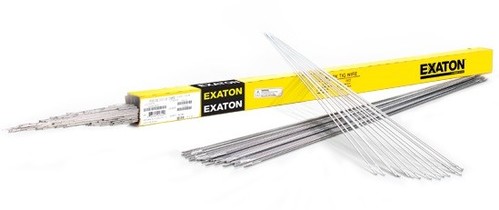
Exaton Ni54 (GTAW)
Exaton Ni54 is a nickel-chrome-molybdenum alloy of type alloy C-22. It is a versatile alloy with excellent wet corrosion resistance in oxidizing and reducing media. It has better overall corrosion resistance than other Ni-Cr-Mo alloys such as alloy UNS N10276 (2.4819) and alloy UNS N06626 (2.4856). However, in severely reducing media alloy UNS N10276 is preferred where Exaton Ni56 is a better matching consumable. Exaton Ni54 are found in components for organic synthesis, wet chlorine gas, hypochlorite, chlorine dioxide atmosphere and ferric and cupric chloride environments. Typical applications for Exaton Ni54 are geothermal wells, HF furnace scrubbers, pesticide production, flue gas scrubber systems, combustion-resistant components for high pressure oxygen service electrolytic galvanizing, plate heat exchangers, phosphoric acid production phosphoric acid production, SO cooling towers and for weld overlays on valves. Exaton Ni54 is used for joining alloy UNS N06022 (2.4602) and is widely used as overmatching filler material for alloy UNS N10276 (2.4819) and other nickel-chrome-molybdenum alloys for better weld metal properties. Exaton Ni54 can also be used for dissimilar joining of stainless steels to nickel alloys.
Classification
SFA/AWS A5.14: ERNiCrMo-10
Nickel
MIG Wires / TIG Rods (GMAW/GTAW)
All
Exaton Ni56 (GTAW)
Exaton Ni56 is a low carbon nickel-chrome-molybdenum alloy of type alloy C-276. It is a versatile alloy with excellent wet corrosion resistance in oxidizing and especially in reducing media. However, in oxidizing chloride containing environments alloy UNS N06022 (2.4602) is preferred where Exaton Ni54 is a better matching welding consumable. Applications for Exaton Ni56 are found in aggressively corrosive media such as chemical processing plants, pollution control, pulp and paper production, waste treatment and for the recovery of sour natural gas. Exaton Ni56 is used for joining alloy UNS N10276 (2.4819) and other nickel-chrome-molybdenum alloys. Exaton Ni56 is used for joining and overlay welding with TIG. It can also be used for dissimilar metal joining of nickel alloys, stainless steels and low-alloy steels. Applications for Exaton Ni56 are found in cryogenics, components in pulp and paper plants such as bleaching vessels, flue gas scrubber systems, components in sour-gas service, sulphuric acid coolers, chlorine gas, hypochlorite and chlorine dioxide atmosphere. Exaton Ni56 is also used in combustion-resistant components for high pressure oxygen service.
Classification
SFA/AWS A5.14: ERNiCrMo-4
Shielding Gas
I1 (EN ISO 14175)
Nickel
MIG Wires / TIG Rods (GMAW/GTAW)
All
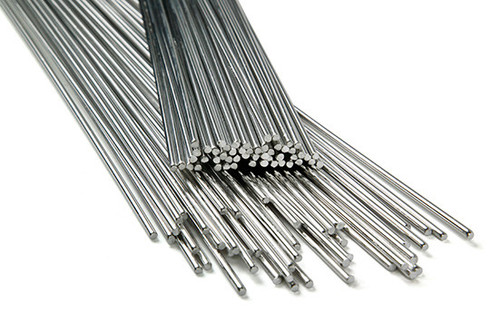
OK Tigrod 19.82
A nickel-based, corrosion- and heat-resistant, 22% Cr, 9% Mo, 3.5% Nb rod for the GTAW of high-alloyed steel, heat-resistant steel, corrosion-resistant steel, 9% Ni steels and similar steel with high notch toughness at low temperatures. It is also suitable for joining dissimilar metals of the types mentioned above. OK Tigrod 19.82 is normally welded with pure Ar as the shielding gas.
Classification
SFA/AWS A5.14: ERNiCrMo-3
Nickel
MIG Wires / TIG Rods (GMAW/GTAW)
All
OK Autrod NiCrMo-3
Bare corrosion and heat-resisting Ni-Cr-Mo rod for welding of high alloyed heat-resisting and corrosion resisting materials, 9%Ni-steels and similar steels with high notch toughness at low temperatures. The filler metal is also used for welding of dissimilar joints containing non- and low alloyed steel. The weld metal has good mechanical properties at high and low temperatures. Good resistance to pitting corrosion and stress corrosion cracking. The alloy is extensively required for weld cladding of valve components and pipe inner diameters in oil and gas applications.
Classification
SFA/AWS A5.14: ERNiCrMo-3
Shielding Gas
I1, I3, M12 (EN ISO 14175)
Nickel
MIG Wires / TIG Rods (GMAW/GTAW)
All
Exaton Ni55 (GTAW)
Exaton Ni55 is a nickel-chrome-molybdenum alloy of type alloy 686 and is the highest alloyed of all Ni-Cr-Mo alloys. Exaton Ni55 is used for joining nickel alloy such as UNS N06022 (2.4602), UNS N06059 (2.4605), UNS N10276 (2.4819) and super duplex. The material is thermally unstable at temperatures above 1200°C (2192°F) resulting in great risk for intermetallic phases after welding. Exaton Ni55 provides the best corrosion resistance in most applications and is particularly useful for weld overlay surfacing of boiler tubes in waste-to-energy boilers. Also, the material can be used in the petrochemical, chemical, oil and gas and marine industries. Exaton Ni55 can also be used for dissimilar joining of stainless steels to nickel alloys and for overlay welding.
Classification
SFA/AWS A5.14: ERNiCrMo-14
Nickel
MIG Wires / TIG Rods (GMAW/GTAW)
All
Exaton Ni41Cu (GTAW)
Exaton Ni41Cu welding wire is suitable for overlay welding when a deposit with chemistry corresponding to UNS N08825 is required, i.e nickel-iron-chromium-molybdenum-copper. Exaton Ni41Cu has very good resistance to stress corrosion cracking (SCC) in chloride containing environments and is particularly suited for use in reducing environments such as those containing sulphuric and phosphoric acids. Exaton Ni41Cu is used for corrosion resistant alloy surfacing of components in the chemical, pollution control, oil & gas and petrochemical industries and often in connection with sour gas service, typically tanks, heat exchangers, evaporators, transport pipes and scrubbers.
Classification
SFA/AWS A5.14: ERNiFeCr-1
Nickel
MIG Wires / TIG Rods (GMAW/GTAW)
All
Exaton Ni60 (GTAW)
Exaton Ni60 welding wire is suitable for joining nickel-chromium-molybdenum nickel alloys and chromiumnickel-molybdenum steels with very high corrosion resistance in oxidizing, aqueous and high temperature environments such as 6Mo-steels, UNS N06625 (2.4856) and corresponding grades. It is also suitable for joining stainless steels and nickel alloys for high-temperature service. Exaton Ni60 can also be used for dissimilar joining of stainless steels to nickel alloys, for overlay welding and is available as both wire and rod. Applications for Exaton Ni60 are found in cryogenics, components subject to high temperature service up to 980°C (1800°F) such as aircraft ducting, engine exhaust systems, power boilers and recovery boilers and a diversity of seawater applications. The combination of strength and corrosion resistance over a wide range of temperatures is utilized in reaction vessels, line pipe distillation columns and heat exchangers.
Classification
SFA/AWS A5.14: ERNiCrMo-3
Shielding Gas
I1, I3, R1 (EN ISO 14175)
Nickel
MIG Wires / TIG Rods (GMAW/GTAW)
All
Exaton Ni54 (GMAW)
Exaton Ni54 is a nickel-chrome-molybdenum alloy of type alloy C-22. It is a versatile alloy with excellent wet corrosion resistance in oxidizing and reducing media. It has better overall corrosion resistance than other Ni-Cr-Mo alloys such as alloy UNS N10276 (2.4819) and alloy UNS N06626 (2.4856). However, in severely reducing media alloy UNS N10276 is preferred where Exaton Ni56 is a better matching consumable. Exaton Ni54 are found in components for organic synthesis, wet chlorine gas, hypochlorite, chlorine dioxide atmosphere and ferric and cupric chloride environments. Typical applications for Exaton Ni54 are geothermal wells, HF furnace scrubbers, pesticide production, flue gas scrubber systems, combustion-resistant components for high pressure oxygen service electrolytic galvanizing, plate heat exchangers, phosphoric acid production phosphoric acid production, SO cooling towers and for weld overlays on valves. Exaton Ni54 is used for joining alloy UNS N06022 (2.4602) and is widely used as overmatching filler material for alloy UNS N10276 (2.4819) and other nickel-chrome-molybdenum alloys for better weld metal properties. Exaton Ni54 can also be used for dissimilar joining of stainless steels to nickel alloys, for overlay welding and it is used for MIG/MAG welding as well as hot wire TIG and mechanical TIG.
Classification
SFA/AWS A5.14: ERNiCrMo-10
Nickel
MIG Wires / TIG Rods (GMAW/GTAW)
All
Exaton Ni59 (GMAW)
Exaton Ni59 is a versatile alloy with excellent wet corrosion resistance for the most demanding applications. It combines excellent corrosion resistance in oxidizing and reducing media, has excellent resistance in chloride containing media and to localized corrosion environments. Exaton Ni59 has excellent thermal stability compared to other common nickel alloys and has therefore outstanding resistance to intermetallic precipitation during welding. Applications for Exaton Ni59 are found in aggressive and contaminated corrosive media including scrubbers for flue gas desulfurisation (FGD), chemical process plants and in severe offshore and petrochemical environments. Furthermore, Exaton Ni59 can be used in contaminated mineral acid environments such as sulfuric acid, hydrochloric acid, phosphoric acid, nitric acid etc. Components in sulfuric acid coolers, digesters and bleachers. Chemical, petrochemical, marine, pharmaceutical, energy production and pollution control. Exaton Ni59 is used for joining matching alloys or dissimilar joining to other nickel alloys such as UNS N10276 (2.4819), type UNS N06022 (2.4602), UNS N06625 (2.4856) and N08825 (2.4858). It provides strong, tough, Nb free weld metal for dissimilar welds in super-austenitic and super-duplex/hyper-duplex stainless steel joints or combinations of these with nickel alloys. Exaton Ni59 is used for joining and overlay welding with MIG/MAG, plasma and hot wire TIG and mechanized TIG. Exaton Ni59 is approved in ISO15156/MR0175 (highest test level VII in sour-gas environments).
Classification
SFA/AWS A5.14: ERNiCrMo-13
Nickel
MIG Wires / TIG Rods (GMAW/GTAW)
All
Exaton Ni59 (GTAW)
Exaton Ni59 is a nickel-chrome-molybdenum alloy of type alloy 59. It is a versatile alloy with excellent wet corrosion resistance for the most demanding applications. It combines excellent corrosion resistance in oxidizing and reducing media, has excellent resistance in chloride containing media and to localized corrosion environments. Exaton Ni59 has excellent thermal stability compared to other common nickel alloys and has therefore outstanding resistance to intermetallic precipitation during welding. Applications for Exaton Ni59 are found in aggressive and contaminated corrosive media including scrubbers for flue gas desulfurisation (FGD), chemical process plants and in severe offshore and petrochemical environments. Furthermore, Exaton Ni59 can be used in contaminated mineral acid environments such as sulfuric acid, hydrochloric acid, phosphoric acid, nitric acid etc. Components in sulfuric acid coolers, digesters and bleachers. Chemical, petrochemical, marine, pharmaceutical, energy production and pollution control. Exaton Ni59 is used for joining matching alloys or dissimilar joining to other nickel alloys such as UNS N10276 (2.4819), type UNS N06022 (2.4602), UNS N06625 (2.4856) and N08825 (2.4858). It provides strong, tough, Nb free weld metal for dissimilar welds in super-austenitic and super-duplex/hyper-duplex stainless steel joints or combinations of these with nickel alloys. Exaton Ni59 is also used for overlay welding and is available as both wire and rod. Exaton Ni59 is approved in ISO15156/MR0175 (highest test level VII in sour-gas environments).
Classification
SFA/AWS A5.14: ERNiCrMo-13
Nickel
MIG Wires / TIG Rods (GMAW/GTAW)
All
Exaton Ni53 (GMAW)
Exaton Ni53 is a nickel-chrome-cobalt-molybdenum alloy of type alloy 617. It has an excellent resistance to high temperature corrosion such as oxidation and carburization. The weld metal provides a combination of excellent metallurgical stability and strength in short and long term exposure to temperatures up to 1100°C (2012°F). Applications for Exaton Ni53 are found in high temperature heat exchangers and valves, furnace tubing in the petrochemical industry, radiant heat tubes, gas turbines, components subjected to high temperatures in the chemical processing industry and components for power plants. Exaton Ni53 is suitable for joining heat resistant nickel alloys, heat resistant austenitic and cast alloys such as: – UNS N08810 (1.4958) – UNS N08811 (1.4959) – UNS N06617 (2.4663) Exaton Ni53 can also be used for dissimilar joining of stainless steels to nickel alloys, for overlay welding and it is used for MIG/MAG welding as well as hot wire TIG and mechanical TIG.
Classification
SFA/AWS A5.14: ERNiCrCoMo-1
Nickel
MIG Wires / TIG Rods (GMAW/GTAW)
All
Exaton Ni53 (GTAW)
Exaton Ni53 is a nickel-chrome-cobalt-molybdenum alloy of type alloy 617. It has an excellent resistance to high temperature corrosion such as oxidation and carburization. The weld metal provides a combination of excellent metallurgical stability and strength in short and long term exposure to temperatures up to 1100°C (2012°F). Applications for Exaton Ni53 are found in high temperature heat exchangers and valves, furnace tubing in the petrochemical industry, radiant heat tubes, gas turbines, components subjected to high temperatures in the chemical processing industry and components for power plants. Exaton Ni53 is suitable for joining heat resistant nickel alloys, heat resistant austenitic and cast alloys such as: – UNS N08810 (1.4958) – UNS N08811 (1.4959) – UNS N06617 (2.4663) Exaton Ni53 can also be used for dissimilar joining of stainless steels to nickel alloys and for overlay welding.
Classification
SFA/AWS A5.14: ERNiCrCoMo-1
Nickel
MIG Wires / TIG Rods (GMAW/GTAW)
All
Exaton Ni72HP (GMAW)
Exaton Ni72HP is filler material for joining NiCrFe alloys; - UNS N06600, UNS N06601, UNS N06690, UNS N08810 and UNS N08330. - 9% Ni steels used at cryogenic temperatures - stainless steels to carbon steels - high service temperature NiCu alloys to carbon steels and - NiCu alloys to nickel alloys - dissimilar joining of stainless steels to nickel alloys Exaton Ni72HP can be used in air up to 1175°C (2145°F) and in sulphur dioxide atmospheres up to 800°C (1470°F). The alloy is used for overlay welding with MIG/MAG, plasma and hot wire TIG and mechanized TIG.
Classification
SFA/AWS A5.14: ERNiCr-3
Nickel
MIG Wires / TIG Rods (GMAW/GTAW)
All
Exaton Ni72HP (GTAW)
Exaton Ni72HP is filler material for joining NiCrFe alloys; - UNS N06600, UNS N06601, UNS N06690, UNS N08810 and UNS N08330. - 9% Ni steels used at cryogenic temperatures - stainless steels to carbon steels - high service temperature NiCu alloys to carbon steels and - NiCu alloys to nickel alloys - dissimilar joining of stainless steels to nickel alloys Exaton Ni72HP can be used in air up to 1175°C (2145°F) and in sulphur dioxide atmospheres up to 800°C (1470°F). The alloy is used for joining and overlay welding.
Classification
SFA/AWS A5.14: ERNiCr-3
Shielding Gas
I1, I3 (EN ISO 14175)
Nickel
MIG Wires / TIG Rods (GMAW/GTAW)
All
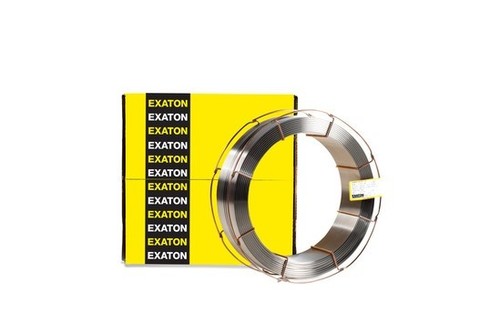
Exaton Ni59 (SAW)
Exaton Ni59 is a nickel-chrome-molybdenum alloy of type alloy 59. It is a versatile alloy with excellent wet corrosion resistance for the most demanding applications. It combines excellent corrosion resistance in oxidizing and reducing media, has excellent resistance in chloride containing media and to localized corrosion environments. Exaton Ni59 has excellent thermal stability compared to other common nickel alloys and has therefore outstanding resistance to intermetallic precipitation during welding. Applications for Exaton Ni59 are found in aggressive and contaminated corrosive media including scrubbers for flue gas desulfurisation (FGD), chemical process plants and in severe offshore and petrochemical environments. Exaton Ni59 is used for joining matching alloys or dissimilar joining to other nickel alloys such as UNS N10276 (2.4819), type UNS N06022 (2.4602), UNS N06625 (2.4856) and N08825 (2.4858). It provides strong, tough, Nb free weld metal for dissimilar welds in super-austenitic and super-duplex stainless steel joints or combinations of these with nickel alloys. Exaton Ni59 can be used for surfacing. Applications for Exaton Ni59 are found in contaminated mineral acid environments such as sulfuric acid, hydrochloric acid, phosphoric acid, nitric acid etc. Components in sulfuric acid coolers, digesters and bleachers. Chemical, petrochemical, marine, pharmaceutical, energy production and pollution control. Exaton Ni59 is approved in ISO15156/MR0175 (highest test level VII in sour-gas environments). Exaton Ni59 is used to weld most of the nickel alloys such as alloy 59, C-22, C-276 etc. It can also be used for joining nickel alloys with duplex stainless steels, super duplex stainless steels and hyper duplex stainless steels. It is used for Submerged Arc Welding.
Classification
SFA/AWS A5.14 : ERNiCrMo-13
Nickel
Subarc (SAW)
All
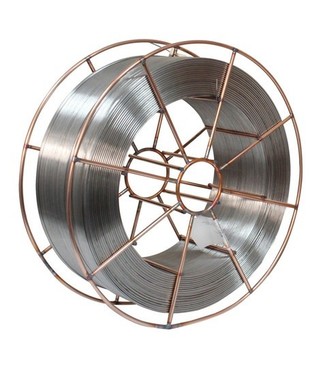
OK Autrod NiCrMo-3
Ni-based solid wire for SAW welding. Corrosion and heat resistant. For welding of high alloyed steels, heat resistant steels, corrosion resistant steels, 9% Ni-steels and similar steels with high toughness at low temperatures. OK Autrod NiCrMo-3 can be combined with OK Flux 10.90, OK Flux 10.93, OK Flux 10.16 or OK Flux 10.17.
Classification
SFA/AWS A5.14 : ERNiCrMo-3
Nickel
Subarc (SAW)
All
Exaton Ni56 (SAW)
Exaton Ni56 is a low carbon nickel-chrome-molybdenum alloy of type alloy C-276. It is a versatile alloy with excellent wet corrosion resistance in oxidizing and especially in reducing media. However, in oxidizing chloride containing environments alloy UNS N06022 (2.4602) is preferred where Exaton Ni54 is a better matching welding consumable. Applications for Exaton Ni56 are found in aggressively corrosive media such as chemical processing plants, pollution control, pulp and paper production, waste treatment and for the recovery of sour natural gas. Exaton Ni56 is used for joining alloy UNS N10276 (2.4819) and other nickel-chrome-molybdenum alloys. It can also be used for dissimilar metal joining of nickel alloys, stainless steels and low-alloy steels. Exaton Ni56 can be used for surfacing low alloyed steels. Applications for Exaton Ni56 are found in cryogenics, components in pulp and paper plants such as bleaching vessels, flue gas scrubber systems, components in sour-gas service, sulphuric acid coolers, chlorine gas, hypochlorite and chlorine dioxide atmosphere. Exaton Ni56 is also used in combustion-resistant components for high pressure oxygen service It is used for Submerged Arc Welding and recommended flux is Exaton 15W.
Classification
SFA/AWS A5.14 : ERNiCrMo-4
Nickel
Subarc (SAW)
All
OK Autrod NiCrMo-4
OK Autrod NiCrMo-4 is a corrosion and heat resistant, nickel-chromium wire for submerged arc welding of high alloyed steel, heat resistant steel, corrosion resistant steel, 9Ni steels and similar steels with high notch toughness at low temperatures. OK Autrod NiCrMo-4 can be combined with OK Flux 10.99, OK Flux 10.90 or OK Flux 10.16.
Classification
SFA/AWS A5.14 : ERNiCrMo-4
Nickel
Subarc (SAW)
All
Product Not Found
Start Over